


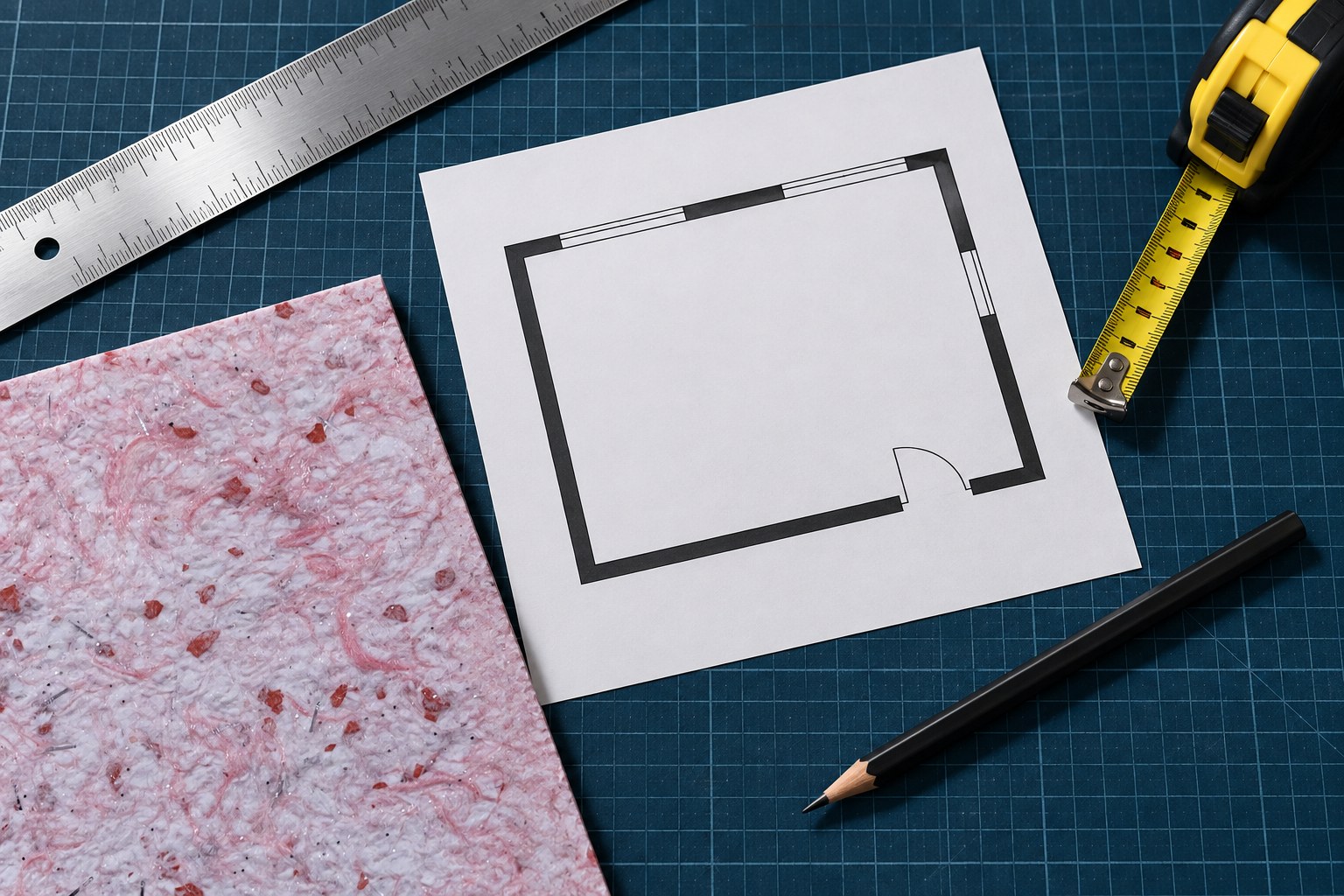
Measure each surface, not the floor
For a rectangular wall, multiply its width by its height. Add the walls you intend to finish, then subtract the openings that will not be coated. Measure window and door reveals separately if the same material will continue onto them.
Divide an irregular wall into manageable rectangles and triangles. Note areas behind built-in furniture explicitly: whether they are included is a scope decision, not something the calculator can know. Keep every measurement in metres so the result is in square metres.
A worked example you can check
Imagine a room 4 m long and 3 m wide, with a wall height of 2.7 m. All four walls will be coated. The perimeter is 14 m, so the gross wall area is 14 × 2.7 = 37.8 m². A 0.9 × 2.1 m door removes 1.89 m²; a 1.5 × 1.4 m window removes another 2.10 m². Net area: 33.81 m², excluding reveals.
AVRORA estimates with 3.25 m² per pack: 33.81 ÷ 3.25 = 10.4 packs. Round up once, at the end: 11 packs. On a perfectly levelled wall (up to 4 m² per pack) 9 would be enough; if the substrate still needs work (around 3 m²), plan for 12.
What affects coverage
The area printed on the pack is a guide, not a guarantee. AVRORA’s video guide names the main factors: wall preparation, how well the wall was levelled beforehand, each installer’s application style and the number of corners in the room.
The material goes on in a thin layer of about 1 mm. Fill chips and holes in advance: using the wallpaper itself to level the wall makes the layer thicker and consumption higher. AVRORA quartz primer gives the wall a slightly rough surface, so the material bonds better, spreads more easily and is not wasted.
- Fill chips and holes, then prime and skim the walls before application.
- Use quartz primer — it prevents excess consumption.
- Keep the layer at about 1 mm; thicker is not better.
- Allow extra for rooms with many corners and reveals.
- Keep one pack and the batch details for future repairs.
Video guide
How to apply AVRORA liquid wallpaper
Check it in the calculator
For a quick estimate, enter the room dimensions and the number of windows and doors. The calculator deducts standard openings and counts packs at 3.25 m² each.
The professional tab lets you enter each surface separately, add reveals, choose the wall condition and layer thickness, and set a waste allowance, repair stock and your own price. Copy the result to share it with a client or our team.
Turn a quantity into a useful budget
Multiply the whole-pack quantity by the confirmed pack price. Then add substrate preparation, primer, tools, labour and delivery as separate lines. This prevents a low material price from disguising an incomplete quotation.
If several colours or products are used, calculate each one separately and round each product’s order to whole packs. Do not combine their areas under one coverage figure. Ask whether the required quantity can be supplied together, and keep the product and batch information with your project notes.
What to send for a quantity check
A simple labelled sketch is usually more useful than a room photograph alone. Include wall widths and heights, openings, reveals, the surfaces excluded from the work and the selected product. Ask the supplier to state the coverage and allowance used in the estimate. You should be able to follow the calculation without guessing what any number means.
Find the finish that fits your project
Explore AVRORA collections or tell us about your room. We can help clarify the product, preparation and quantity before you order.
